Is your car’s engine secretly failing emissions due to invisible buildup? For drivers across the United States, passing a smog check is a strict legal requirement. Failing can lead to denied registration, hefty fines, and a vehicle you can’t legally drive. This problem often stems from harmful deposits inside the motor. These accumulations reduce fuel economy and cause your auto to pollute more. Stricter environmental rules make this issue more common than ever. A leading solution has emerged: hydrogen carbon cleaning. This advanced service tackles the root cause of excess pollutants. It works to restore your powerplant’s efficiency and lower its emissions output.

The method is non-invasive. It doesn’t require taking the motor apart. This makes it a cost-effective form of preventative maintenance that can avoid expensive repairs.

Our guide provides clear, actionable steps. You will learn how this process works and how to use it to achieve compliance. Let’s ensure your next inspection is a success.

Key Takeaways

  • Passing emissions tests is a legal mandate for vehicle registration in the U.S.
  • Failing a test can result in fines and the inability to legally drive your car.
  • Engine deposits are a common, hidden cause of test failure and increased pollution.
  • Hydrogen carbon cleaning is a top method for removing these deposits without disassembly.
  • This service restores engine performance, helps pass inspections, and can save money.
  • The process is environmentally friendly, reducing your vehicle’s harmful emissions.
  • This article will provide a practical guide to using this solution for test success.

Understanding Vehicle Emissions Tests and Common Failure Causes

A detailed vehicle emissions testing and engine component diagram, showcasing a professional workspace. In the foreground, a high-tech emissions testing machine with glowing indicators and a control panel, featuring buttons and screens displaying data readings. The middle ground includes an open engine hood, revealing clean, well-organized engine components, such as the catalytic converter, fuel injectors, and exhaust system parts, with labels for clarity. The background consists of a clean, illuminated garage with tools neatly arranged on a wall. The lighting is bright and focused, emphasizing the technical aspects, while capturing a mood of precision and professionalism in the automotive field. Ensure no human figures are present in the image.

Failing an emissions test can halt your registration, but the root cause is often hidden deep within the motor’s internal workings. To pass inspection, you must first understand what the test measures and how internal deposits lead to failure.

What Are Emissions Tests and Why Do They Matter in the US?

Vehicle emissions tests are state-mandated procedures. They measure the levels of specific pollutants exiting a car’s tailpipe. Compliance is not optional in many regions; it’s a legal requirement for registration.

These tests matter for two key reasons. Legally, non-compliance can result in registration suspension. Environmentally, they are a frontline defense against urban smog and poor air quality.

During testing, technicians analyze exhaust gases for several harmful substances. The primary pollutants measured are:

PollutantSymbolPrimary Source
Carbon MonoxideCOIncomplete fuel combustion
HydrocarbonsHCUnburned fuel
Nitrogen OxidesNOxHigh-temperature combustion
Particulate MatterPMSoot and ash particles

Elevated levels of any of these will cause your automobile to fail the inspection.

How Carbon Buildup Leads to Increased Emissions and Test Failures

The formation of harmful deposits begins with incomplete combustion. In an internal combustion engine, not all fuel burns perfectly. This leaves behind solid residue.

Modern, efficient motors often run at lower temperatures. Stricter exhaust recirculation rules can also contribute. These conditions allow more and more residue to settle on critical parts.

This accumulation acts like a sponge. It disrupts the precise air-fuel mixture needed for clean burning. The result is a richer combustion process.

Richer combustion produces more of the pollutants the test looks for. Specifically, it increases carbon monoxide and unburned hydrocarbons. This direct link is why deposit-related failures are so common.

Key Engine Components Affected by Carbon Deposits

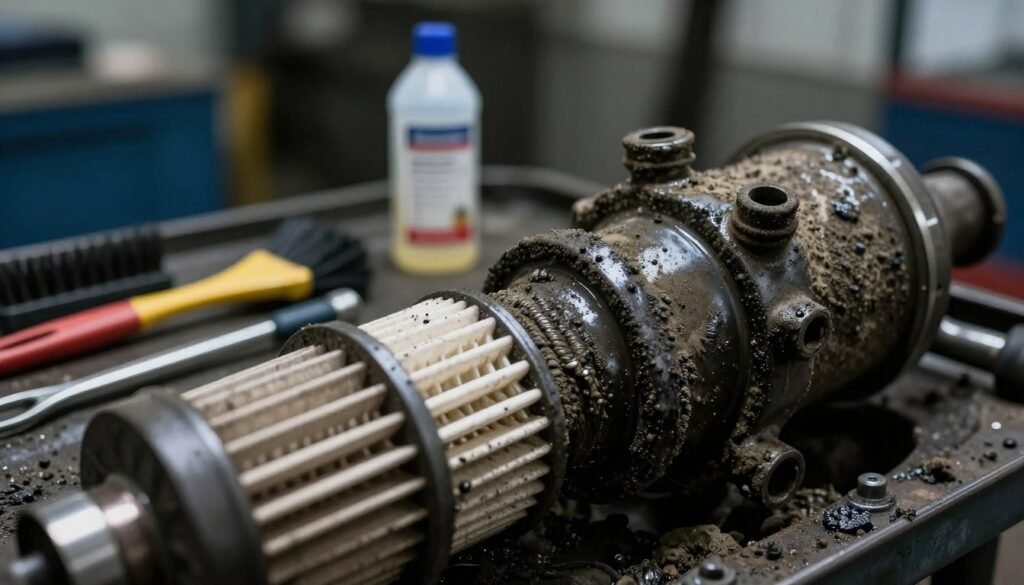
Deposits do not form evenly. They target specific, vital engine components. The most vulnerable parts include intake and exhaust valves, piston rings, and cylinder heads.

In modern vehicles, expensive parts are also at risk. Turbochargers, EGR valves, and diesel particulate filters (DPFs) commonly suffer from blockage.

Problems on one part create a cascade effect. For example, sticky intake valves cause poor sealing. This leads to more deposits forming elsewhere in the chamber and exhaust system.

The physical blockage increases backpressure. This reduces overall motor efficiency. Power drops, fuel economy suffers, and tailpipe emissions rise steadily.

This process is often gradual. Even a well-maintained vehicle can develop issues over time. Short, stop-and-go driving cycles accelerate the problem.

Declining performance and mileage are early warning signs. They often appear long before the official smog check failure. Addressing buildup at this stage can prevent a costly test result.

What Is Carbon Cleaning Hydrogen?

A professional and sophisticated hydrogen carbon cleaning equipment setup in a well-lit garage workshop. In the foreground, a sleek, advanced hydrogen carbon cleaning machine with glowing control panels and hoses connecting to various engine components. The middle ground features a mechanic in professional attire, observing the machine's operation, with an air of expertise and focus. In the background, shelves are stocked with automotive tools and parts, under bright fluorescent lighting that highlights the cleanliness and precision of the environment. The overall atmosphere conveys innovation and trust, reflecting the cutting-edge technology of emissions reduction. The angle is slightly elevated, showcasing the equipment's intricate design and functionality in action, emphasizing efficiency and professionalism.

Imagine clearing harmful buildup from your motor without taking it apart, using only water and electricity. This is the promise of a modern maintenance service. It directly tackles the root cause of many emissions failures.

The method is known professionally as hydrogen carbon cleaning. It represents a shift from reactive fixes to proactive care for your automobile.

Defining Hydrogen Carbon Cleaning and Its Role in Engine Maintenance

This service is a non-invasive procedure. It uses a specialized gas to remove stubborn deposits from inside a motor. Think of it as a deep clean for the combustion chamber and intake tract.

Its role is critical in preventative upkeep. Just as you change oil to protect moving parts, this process safeguards internal surfaces. It helps maintain optimal air-fuel mixing and combustion efficiency.

Over time, all internal combustion engines develop residue. This service addresses that inevitable wear. It is a key step in preserving your vehicle’s health and avoiding future problems.

The Science Behind HHO Gas and Oxy-Hydrogen Generation

The core of this method is a simple chemical reaction. Specialized equipment uses electrolysis. It passes an electrical current through distilled water (H₂O).

This current splits the water molecules. It separates them into hydrogen (H₂) and oxygen (O₂) gas. The resulting mixture is often called HHO or oxy-hydrogen gas.

This gas is highly reactive but safe in controlled amounts. It is produced on-demand by the machine. The gas is then fed directly into the motor’s air intake system.

Once inside the combustion cycle, HHO acts as a powerful catalyst. It does not use harsh chemical solvents. Instead, it facilitates a reaction that changes solid residue back into a harmless gas.

Types of Engines Compatible with Hydrogen Cleaning: Gasoline and Diesel

This cleaning process is versatile. It works effectively on both gasoline (petrol) and diesel powerplants. This includes older naturally aspirated models and modern turbocharged variants.

From everyday passenger cars and SUVs to light-duty trucks and commercial rigs, most vehicles can benefit. The service is performed with the motor running at idle. This allows the gas to circulate through the entire system.

It is important to note this is a professional procedure. It requires certified technicians and specific HHO generation equipment. It is not a DIY fuel additive you pour into the tank.

The safety profile is excellent. The reactive gas is made in small, controlled quantities. It is consumed immediately in the combustion process, leaving no harmful byproducts.

How Hydrogen Carbon Cleaning Works to Remove Deposits

A precise, four-stage method is employed to safely eliminate internal residue from your automobile. This professional procedure is non-invasive and systematic.

It targets the root cause of performance loss and high emissions. The goal is to restore your motor’s original efficiency without any disassembly.

Step 1: Electrolysis and Production of Oxy-Hydrogen Gas

The service begins with a specialized machine. This unit contains an electrolysis cell filled with distilled water.

An electrical current is applied to the water. This splits the H₂O molecules into their base elements.

The result is a mixture of oxy-hydrogen, often called HHO gas. The equipment carefully controls the production rate.

This ensures the gas flow matches your specific motor’s size and intake airflow. Safety and effectiveness are prioritized from the start.

Step 2: Introducing the Gas into the Engine’s Air Intake

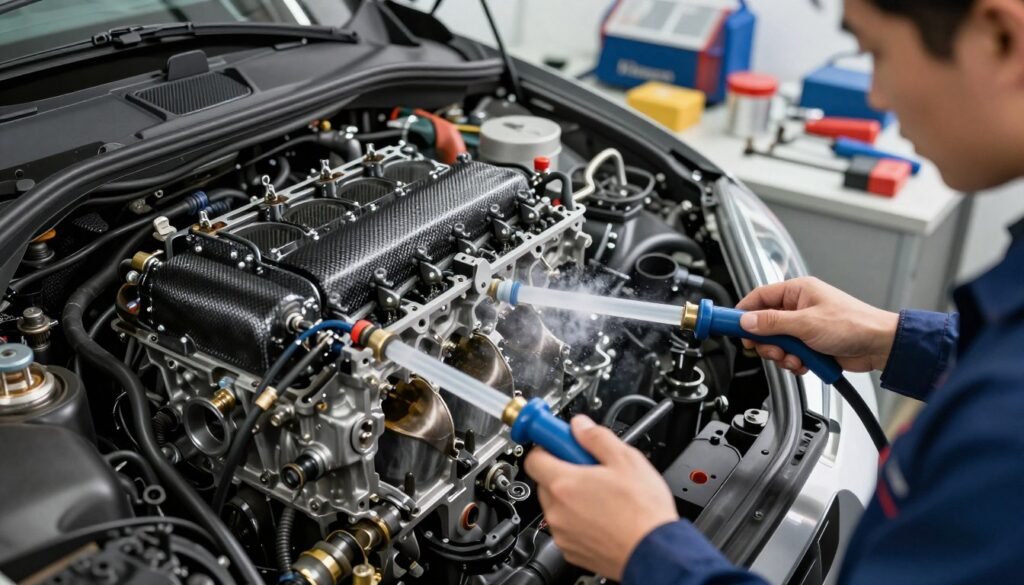
While your motor runs at a high idle, the generated HHO gas is introduced. A hose connects the machine to the air intake manifold or a vacuum line.

It is crucial to understand the engine continues to run on its normal fuel. The HHO acts as a cleaning additive, not a primary fuel source.

This allows the active gas to be distributed evenly. It flows into the combustion chambers alongside the standard air-fuel mixture.

Step 3: The Combustion Reaction That Transforms Carbon to Gas

Inside the chamber, the introduced molecules increase the combustion temperature. They also act as powerful catalysts.

The high heat and catalytic action break molecular bonds in the hard deposits. This converts the solid residue into harmless gaseous byproducts.

Chemically, solid carbon (C) becomes carbon dioxide (CO₂) and water vapor (H₂O). This reaction occurs progressively across all cylinders.

Every piston cycle helps clear accumulation from valves, rings, and chamber surfaces.

Step 4: Expelling Carbon Through the Exhaust System

The newly created gaseous byproducts are carried away. They exit the combustion chamber with the normal exhaust flow.

This is how the removed buildup safely leaves your vehicle. The entire procedure typically takes 30 to 90 minutes.

Duration depends on motor size and the severity of the deposits. A key advantage is the separation from the lubrication system.

The oil and filter remain completely unaffected. No post-service oil change is required.

StepKey ActionPrimary Outcome
1. ElectrolysisMachine uses electricity to split distilled water into HHO gas.On-demand production of a reactive cleaning agent.
2. Intake IntroductionHHO gas is fed into the air intake while the engine idles.Even distribution of the cleaning agent to all cylinders.
3. Combustion ReactionGas increases heat and acts as a catalyst in the chamber.Solid carbon deposits are chemically transformed into gas.
4. Exhaust ExpulsionGaseous byproducts join and exit with the normal exhaust stream.Removed deposits are safely eliminated from the engine.

Key Benefits of Hydrogen Carbon Cleaning for Emissions Compliance

A detailed illustration showcasing the benefits of hydrogen carbon cleaning for emissions compliance. In the foreground, a professional expert in business attire carefully inspects a clean engine after hydrogen carbon cleaning, demonstrating the process's efficacy. In the middle, various icons symbolize key benefits: improved fuel efficiency, reduced emissions, and prolonged engine life. The background features a bright, modern automotive workshop with tools and equipment, emphasizing a clean and organized environment. The lighting is bright and focused, highlighting the expert and the components being inspected, with soft shadows to create depth. The atmosphere is positive and professional, conveying trust and expertise in modern automotive care.

Beyond just passing a smog check, this advanced procedure delivers a suite of measurable improvements. It tackles the core issues that cause test failures while enhancing your automobile’s overall operation.

The advantages are environmental, performance-based, and financial. Investing in this form of maintenance provides a strong return for any driver.

Reducing Harmful Tailpipe Emissions: CO, NOx, and Particulates

This service directly targets the pollutants measured during an official inspection. By restoring proper combustion, it lowers the levels your vehicle produces.

Carbon monoxide (CO) and unburned hydrocarbons (HC) drop significantly. This happens because fuel burns more completely inside the chamber.

Nitrogen oxide (NOx) output is also reduced. A cleaner motor runs at a more optimal temperature, which helps control NOx formation.

In diesel applications, removing soot from intake paths is crucial. Cleaner valves and piston crowns allow for a more complete fuel burn. This is the primary factor in lowering harmful particulate matter.

Restoring Engine Performance, Fuel Economy, and Acceleration

Drivers often notice a difference immediately after the procedure. Common reports include regained horsepower and much smoother acceleration.

Hesitation and rough idle are typically eliminated. The motor responds more quickly when you press the accelerator.

This restoration directly improves your miles per gallon. With deposits removed, the air-fuel mixture is precise and combustion is efficient.

Industry data shows notable gains. For example, commercial diesel trucks have seen average fuel efficiency improvements of up to 9% after this maintenance.

Preventing Costly Repairs to Turbos, DPFs, and Catalytic Converters

Internal residue doesn’t just hurt emissions. It can cause mechanical failures in expensive downstream parts.

In turbochargers, hard deposits can create imbalance. This may lead to shaft seizure and a complete turbo failure.

A clean intake system helps diesel particulate filters (DPFs) work correctly. It prevents them from clogging prematurely, avoiding forced regenerations.

The catalytic converter is also protected. A cleaner combustion chamber reduces the risk of hot spots and pre-ignition. This shields the converter from meltdown or chemical poisoning.

Cost-Benefit Analysis: Preventative Service vs. Major Repairs

Component at Risk from BuildupTypical Repair Cost RangePreventative Service Cost
Catalytic Converter$945 – $2,475$175 – $450 (for the cleaning service)
Diesel Particulate Filter (DPF)$1,000 – $10,000
Turbocharger$1,800 – $7,000
Note: A single professional session can help prevent these failures, offering significant potential savings.

Extending Engine Life and Avoiding Breakdowns

Regular upkeep with this method does more than fix immediate issues. It promotes the long-term health of your entire powertrain.

Hard deposit particles act like abrasive grit inside the motor. They accelerate wear on piston rings, cylinder walls, and valve guides.

Removing this material reduces that mechanical wear. This helps extend the overall operational life of your vehicle’s powerplant.

Position this service as a key strategy for reliability. It helps you avoid unexpected roadside breakdowns, costly tow bills, and the major inconvenience of extensive mechanical work.

The financial logic is clear. A service costing between $175 and $450 can prevent repairs ranging from $900 for valve work to over $10,000 for a heavy-duty DPF replacement.

Hydrogen Carbon Cleaning vs. Traditional Cleaning Methods

A split-scene illustration showcasing the comparison between hydrogen carbon cleaning and traditional cleaning methods for vehicles. In the foreground, on the left, a sleek, modern vehicle being serviced with advanced hydrogen carbon cleaning technology, with vibrant blue and green streams symbolizing a clean, eco-friendly process. The technician wears professional business attire and examines the vehicle closely. In the middle, contrasting with the left, traditional cleaning methods are depicted using outdated equipment, with dark exhaust and industrial fumes emphasizing pollution. The technician here is also dressed in professional attire, looking worried. The background features a garage setting, well-lit with natural light coming from large windows, providing a bright, optimistic atmosphere on the hydrogen side while the traditional side appears more shadowy and cluttered.

The battle against motor deposits for emissions compliance is fought with three main weapons: fuel additives, physical disassembly, and hydrogen gas cleaning. Each approach has distinct advantages and significant drawbacks.

Choosing the right one affects your wallet, your vehicle’s safety, and the test results. Understanding these differences is crucial for making an informed maintenance decision.

Chemical Additives and Solvents: Risks and Limitations

Liquid fuel system cleaners are a common first attempt. These are low-concentration solutions added to your gas tank. They offer mild cleaning for light residue in the fuel injectors.

They cannot tackle heavy deposits on intake valves or inside the chamber. This is a fundamental limitation of the method.

Concentrated solvent flushes pose greater risks. Some combustion chambers have special coatings that these chemicals can damage. The solvents may also harm turbocharger seals and oxygen sensors.

A major danger is dislodging large chunks of solid material. These chunks can travel, causing downstream blockages. This creates new, expensive repair needs.

All chemical methods rely on the fuel or oil system for transport. This means they completely miss key areas where harmful buildup forms.

Mechanical Disassembly: Invasive, Time-Consuming, and Expensive

Manual scrubbing or walnut blasting is considered the “gold standard” for completeness. Technicians physically take the motor apart to access fouled components.

This process is inherently safe for the parts, as no harsh chemicals are used. However, it comes with major practical drawbacks that drivers must consider.

The primary issue is high labor cost. This intensive service often exceeds $1,000. Your automobile is also out of service for a long time.

There is always a risk during reassembly. Errors can occur, or new gaskets may leak. These potential problems add hidden costs and frustration.

Why Hydrogen Cleaning is Safer, More Effective, and Eco-Friendly

The modern gas-based process stands in clear contrast. It cleans the entire chamber, intake ports, and exhaust-side deposits without any disassembly.

Safety is a top benefit. The service uses only distilled water and electricity. It produces no toxic chemical waste for disposal.

No abrasive media is introduced into the powertrain. This protects all internal components from unintended damage.

Environmental friendliness aligns with the goal of lower emissions. The only byproducts are water vapor and trace amounts of CO2.

Effectiveness is superior because the reactive gas reaches all surfaces exposed to combustion. This includes the backside of valves and piston ring lands.

This method offers the best balance. It provides comprehensive removal, protects your investment, is cost-effective, and is responsible.

Comparison of Engine Deposit Cleaning Methods

MethodHow It WorksPrimary Risks & LimitationsTypical CostIdeal Use Case
Chemical AdditivesLiquid cleaners are added to fuel or oil. They rely on system circulation to transport solvents.Mild cleaning only; cannot address heavy deposits. Risks damage to engine coatings, turbo seals, and O2 sensors. Can dislodge large carbon chunks.$15 – $50 (per bottle)Very light, preventative maintenance for fuel injectors only.
Mechanical DisassemblyPhysical tear-down of engine components (e.g., walnut blasting, manual scrubbing).Extremely high labor cost. Long vehicle downtime. Risk of reassembly errors and new gasket leaks.$1,000 – $2,500+Severe deposit cases where every surface must be visually inspected and cleaned.
Hydrogen Gas CleaningHHO gas is introduced into the intake. A catalytic combustion reaction transforms solid deposits into gas, which is expelled.Requires a qualified technician with proper equipment. Not a DIY solution.$175 – $450Comprehensive cleaning for emissions compliance, performance restoration, and preventative maintenance without invasive work.

For most drivers facing a smog check, the modern gas-based service presents the most logical path. It delivers the needed results without the high cost, long wait, or component risks of older techniques.

Step-by-Step Guide to Using Hydrogen Carbon Cleaning for Emissions Tests

To successfully use modern cleaning technology for compliance, drivers need a straightforward guide from assessment to verification. This roadmap turns a complex procedure into a simple, actionable plan.

Assessing Your Vehicle’s Need for Carbon Cleaning

Your automobile often shows clear signs when internal deposits become a problem. Watch for a noticeable drop in miles per gallon or a loss of power during acceleration.

A rough idle or hesitation when starting cold are other common symptoms. If you recently failed a smog check or received a warning, immediate action is advised.

Before scheduling any work, review your maintenance records. Consider your odometer reading, especially if it’s been over 20,000 miles since the last deep clean.

Check for any diagnostic trouble codes (DTCs) with a scanner. These codes can confirm that poor combustion is affecting your system.

Finding a Qualified Service Provider with HHO Equipment

Start your search locally using terms like “hydrogen carbon cleaning” or “HHO cleaning.” Look for shops with certified technicians and positive customer reviews.

Ask specific questions about their equipment and methods. A reputable provider uses a professional, standalone HHO generator, not a basic bottle system.

Inquire about the technician’s direct experience with this procedure. For example, our team in Ontario, CA, undergoes rigorous training and handles a wide range of engine types.

This includes gasoline, diesel, and even hybrid vehicles. Proper certification ensures the job is done safely and effectively.

What to Expect During the Cleaning Process: Duration and Safety

During your appointment, the technician will connect a specialized machine to your automobile’s air intake. Your motor will then idle for the duration of the service.

The professional monitors key parameters throughout the entire operation. This ensures everything proceeds smoothly and without issues.

Duration depends on your powertrain size. A standard 4-cylinder engine typically takes about 30 minutes.

A large V8 or diesel truck might require up to 90 minutes. The method is very safe for all internal sensors and the catalytic converter.

Only minimal amounts of gas are produced on-demand and consumed immediately. There is no risk of chemical damage or abrasive media inside the components.

Post-Cleaning Verification: Emissions Retesting and Performance Checks

After the service, a short drive cycle is often recommended. This helps fully expel any loosened residues from the exhaust system.

The ultimate verification is a passing emissions retest. Schedule this soon after the procedure to confirm compliance.

You should also monitor your automobile for restored drivability. Smoother acceleration and improved fuel economy are positive indicators.

Keep a detailed record of the service receipt. This document serves as proof of preventative maintenance.

It can be beneficial for warranty discussions or when reselling your vehicle. A clean bill of health adds value and peace of mind.

Conclusion: Achieving Emissions Compliance with Confidence

Securing a clean bill of health from the smog station is the ultimate goal for every responsible vehicle owner. Harmful internal deposits are the primary reason for elevated tailpipe pollutants and test failures. The modern HHO method addresses this issue at its source with a non-invasive, scientific approach.

This professional service does more than just help you pass inspection. It brings back your engine’s responsiveness and improves fuel economy. It also acts as preventative care, shielding costly components like turbochargers and catalytic converters from premature wear.

Consider this procedure standard maintenance for any internal combustion engine, especially where emissions laws are strict. If you notice performance loss or have a test scheduled, consult a qualified technician. With this advanced solution, you can face your next smog check with full confidence in your vehicle’s efficiency and environmental footprint.

Leave a Reply

Your email address will not be published. Required fields are marked *